How to Start a Print on Demand Business in the U.S.: A Complete 9-Step Beginner’s Guide to Choosing Products, Finding Suppliers, Building an Online Store, and Growing a Profitable Brand in 2026

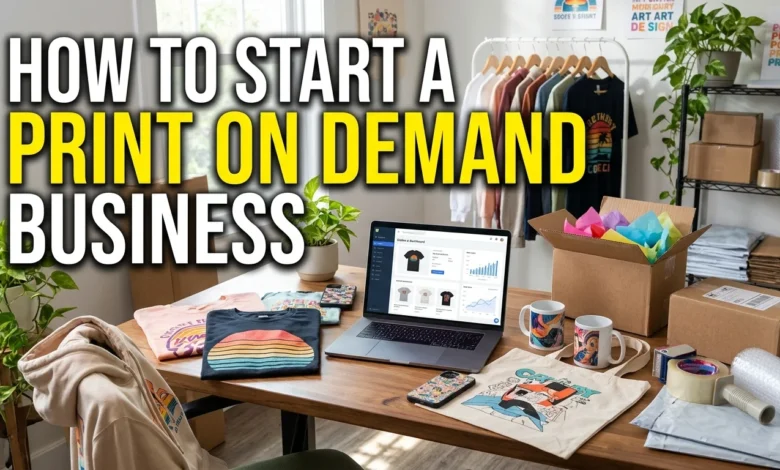
Learning how to start a print on demand business begins with choosing a focused audience and products they want. You then create original designs, connect a fulfillment provider, and open a sales channel. Your supplier prints and ships each item only after a customer orders it.
Direct answer: To start a print-on-demand business, choose a niche, validate demand, and select a few products. Create original designs, compare fulfillment providers, and order samples before launching. Then build a store, calculate profitable prices, handle U.S. business requirements, and market proven products consistently.
| Key Decision | Practical Starting Point |
|---|---|
| Business model | Products made after customers order |
| Starting products | Two to five focused products |
| Sales channels | Etsy, Shopify, or another suitable marketplace |
| Supplier priorities | Quality, cost, production speed, U.S. fulfillment |
| Main startup expenses | Samples, store fees, domain, designs, marketing |
| Legal setup | Depends on your state and business structure |
| Pricing goal | Cover production, fees, shipping, marketing, and profit |
| Launch strategy | Start small, measure sales, then expand |
Why Print-on-Demand Appeals to New U.S. Sellers
POD removes the need to purchase large quantities of inventory before making sales. That reduces the financial risk attached to unsold colors, sizes, and designs. You can test ideas without filling a room with unwanted products.
The tradeoff is lower control over manufacturing and fulfillment. Your supplier affects product quality, shipping speed, packaging, and customer satisfaction. Strong sellers treat supplier selection as an operating decision, not a shortcut.
Current guides also show that startup expenses can remain relatively low. Your actual budget depends on the store, samples, design tools, and promotion you choose. Building a sensible budget matters more than chasing the cheapest possible launch.
How to Start a Print on Demand Business: 9 Practical Steps
The launch process works best when each decision supports the next. Avoid uploading dozens of unrelated designs before learning what customers want. Use the following sequence to build a focused store.
1. Choose a Specific Niche
Start with a recognizable group rather than trying to sell to everybody. Examples include nurses, hikers, dog owners, teachers, gardeners, or regional hobby communities. A narrow audience makes design and marketing decisions easier.
Research what that audience already buys and discusses online. Study marketplace results, search behavior, reviews, social communities, and competing stores. Look for repeated interests that can support several original products.
BusinessVert’s guidance on building a company around a clear customer problem follows the same principle. A focused customer makes your product offer easier to understand. It also gives your marketing a clear direction. BusinessVert’s business success guide
2. Validate Demand Before Creating a Large Catalog
Create a simple list of product ideas after choosing your audience. Check whether buyers already search for similar themes, products, or gift ideas. Existing competition can confirm demand, although crowded categories require stronger differentiation.
Read customer reviews on competing products for useful clues. Buyers often mention poor sizing, weak print quality, slow shipping, or limited design choices. Those complaints can reveal opportunities for your offer.
Do not assume search volume guarantees sales. Your product still needs strong creative, good pricing, and a credible presentation. Test several ideas before committing significant money to promotion.
3. Pick Two to Five Products First
A smaller catalog gives you fewer variables during launch. T-shirts, sweatshirts, mugs, tote bags, posters, and phone accessories are common starting options. Your niche should determine which products make sense.
Compare base costs before choosing your products. A design with a healthy margin on a shirt might produce weak numbers elsewhere. Shipping charges can also change the economics of inexpensive products.
Starting small also makes quality control easier. You can learn from early orders before expanding into more categories. Add products because buyers respond, not because a supplier offers them.
4. Create Designs You Have the Right to Sell
Original work gives you the safest foundation for building a recognizable brand. You can design products yourself or hire a designer under clear commercial-use terms. Keep records showing who created each asset and what rights you received.
Avoid copying logos, characters, celebrity images, sports branding, song lyrics, or protected slogans without permission. A design appearing online does not make it available for commercial use. Check intellectual-property rights before publishing questionable artwork.
Create designs to match the print specifications of your chosen supplier. Review dimensions, resolution, color requirements, and safe printing areas. Good artwork can still print poorly when the source file is unsuitable.
5. Compare POD Suppliers and Order Samples
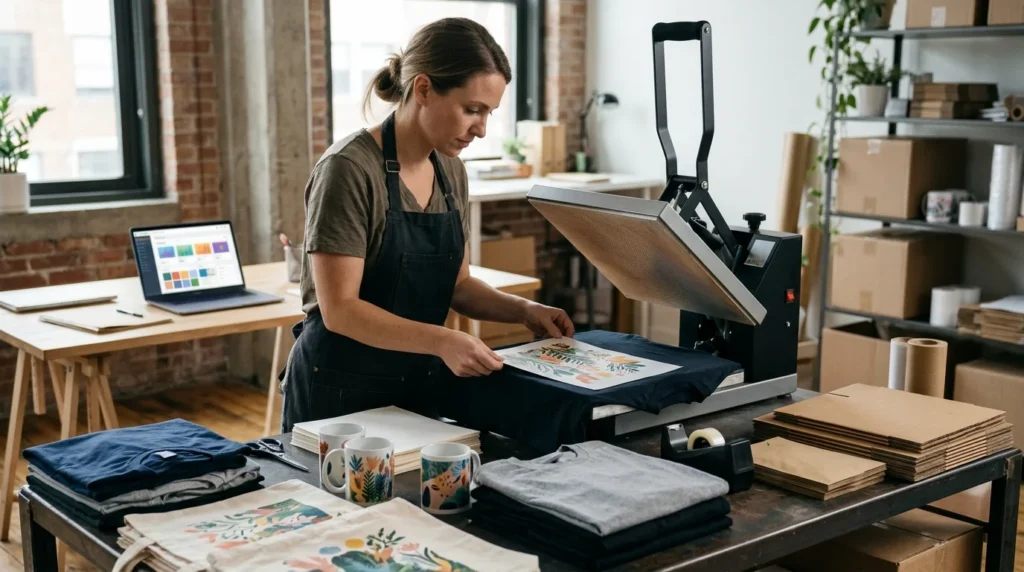
Supplier comparisons should go beyond the advertised base price. Review production locations, catalog quality, shipping estimates, branding options, support, and integration choices. U.S. fulfillment locations can help reduce delivery times for American buyers.
Order samples from the providers you are considering. Check print alignment, color accuracy, garment feel, packaging, and delivery experience yourself. A sample can expose problems that mockups will never show.
Treat this purchase as quality control, not wasted startup money. Customers will associate fulfillment problems with your brand, not your production partner. Test your core products before spending heavily on traffic.
6. Choose Where You Will Sell
Marketplaces and independent stores solve different problems. Etsy provides access to an existing shopping audience but charges selling fees. Shopify gives you greater control but requires you to attract your own visitors.
Etsy currently lists a \$0.20 listing fee and a 6.5% transaction fee. U.S. Etsy Payments also carries payment-processing charges listed by the platform. Sellers should confirm current fees before calculating margins.
Shopify currently lists Basic at \$39 monthly or \$29 monthly with annual billing. Its pricing page also lists payment rates that vary by plan. Compare the complete cost against your expected order volume.
You do not need to launch everywhere at once. One primary channel makes early results easier to interpret. Add another channel after your products and workflow become reliable.
7. Calculate Your Price From Full Unit Economics
Never set prices by copying a competing listing alone. Your price must cover the product, printing, transaction fees, payment fees, shipping, refunds, marketing, and taxes. What remains after those costs is your operating margin.
Consider a shirt selling for \$28 as a simple example. Suppose production and fulfillment consume \$15 before marketplace and advertising expenses. Your usable margin can shrink quickly once every cost is included.
Create a spreadsheet for each product before launch. BusinessVert’s broader business guidance also recommends pricing for profit rather than activity. Consistent sales mean little when each order produces inadequate profit.
8. Handle U.S. Business and Tax Requirements
Your legal requirements depend on your state, location, structure, and activities. The U.S. Small Business Administration recommends choosing a structure, registering when required, and checking licenses and permits. State and local requirements can differ significantly.
A sole proprietorship can be simpler for an early business. An LLC can offer different liability and organizational features as the company grows. Consider professional legal or tax advice when choosing between structures.
You should also investigate sales-tax obligations for your selling channels and locations. Marketplace collection rules do not eliminate every possible business responsibility. Keep clean financial records from your first sale.
BusinessVert’s business-plan article can help organize costs, goals, market research, and sales plans. Even a short operating plan can prevent avoidable spending. Update it when customer behavior gives you better information. BusinessVert’s business planning guide
9. Launch, Market, and Measure What Sells
Launch with enough products to test several design ideas without confusing your audience. Use strong mockups, descriptive product titles, clear sizing information, and useful product descriptions. Your listings should answer common purchase questions before customers need to ask.
Choose marketing channels based on your target buyer. Search content, short videos, social posts, email, creators, or paid advertising can all work. BusinessVert’s marketing guide explains how audience, objectives, channels, and measurement connect. Explore BusinessVert’s marketing strategies guide
Track revenue, conversion rate, product margin, refunds, and customer-acquisition cost. Do not scale advertising because a post receives likes. Increase spending after sales data shows that a product can support it.
Social timing can support distribution, but it cannot rescue weak creative work. BusinessVert’s current U.S. social scheduling guide recommends testing posting windows against your own audience data. Use account analytics to refine the schedule over time. See U.S. social posting benchmarks for 2026
A Simple Beginner Budget
You can start without purchasing bulk inventory, but a serious launch is rarely cost-free. Samples, marketplace listings, domains, store subscriptions, artwork, and promotion can create expenses. Your chosen setup determines the final amount.
| Expense | Lean Approach | Higher-Cost Approach |
|---|---|---|
| POD account | Free provider plan | Paid provider features |
| Store | Marketplace listings | Independent ecommerce store |
| Designs | Self-created | Freelance designer |
| Samples | One or two core items | Several products and variants |
| Marketing | Organic content | Paid advertising tests |
| Domain | Optional on some marketplaces | Usually advisable for a branded store |
Protect cash during the testing stage. Spend first on product quality and proof of demand. Increase marketing expenses after you understand your contribution margin.
Common Mistakes That Hurt New POD Stores
Beginners often create too many products before finding a winning audience. They also copy broad trends without creating a distinct reason to buy. A smaller, clearer collection usually produces better learning.
Another mistake is calculating profit from selling price minus production cost. Marketplace fees, payment processing, shipping, returns, and advertising can change the result. Track the complete cost for every sale.
Skipping samples creates another avoidable risk. Attractive digital mockups cannot confirm fabric quality or print accuracy. Test what customers will receive before promoting it widely.
Frequently Asked Questions
How to start a print on demand business with little money?
Start with one niche, several original designs, and a free supplier account. Use a low-cost marketplace before paying for advanced store features. Spend your first budget on samples and basic product validation.
Do I need an LLC to start selling POD products?
You don’t automatically need an LLC just because you start selling products. Your structure depends on liability, taxes, state rules, and your business circumstances. Review state requirements and seek professional advice when needed.
Is a POD business profitable?
It can generate profit when your pricing leaves enough money after every business expense. Results depend on demand, product quality, margins, marketing costs, and repeat purchases. Calculate profitability at the individual product level instead of relying on revenue alone.
Should beginners use Etsy or Shopify?
Etsy can help beginners reach shoppers who already use its marketplace. Shopify gives you more control over branding and the customer relationship. Your better choice depends on budget, traffic strategy, fees, and long-term goals.
Build Around Evidence, Not a Huge Catalog
A successful POD store does not need hundreds of products on launch day. It needs a clear audience, original designs, reliable fulfillment, and prices that leave sustainable margins. Let early sales data decide which products deserve more attention.
Start with a small collection and order samples before promoting it widely. Measure which products convert and which marketing channels produce profitable customers. Remove weak offers instead of spending more money trying to force demand.
Once you find repeatable sales, expand carefully into related designs and products. Keep tracking costs as volume grows because revenue alone can hide weak margins. Treat the store as a business from its first order.