Delaware Business Lookup: How to Find Entity Details, Status, and Records

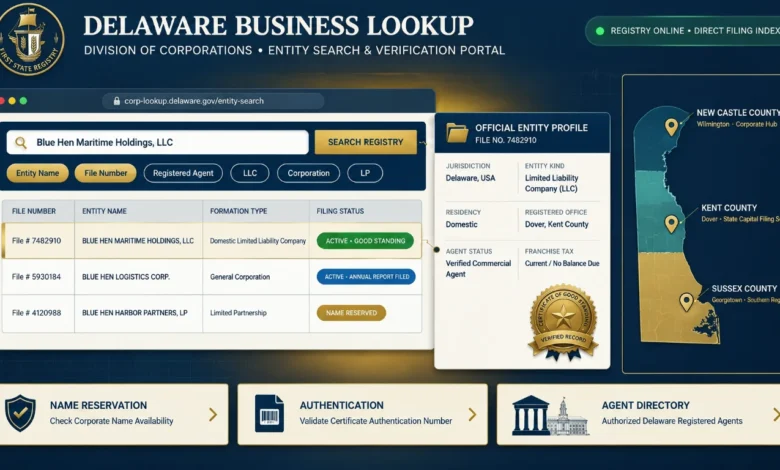
A Delaware business lookup helps you find public information about companies registered with the state. You can search by entity name or Delaware file number. The official database is maintained by the Delaware Division of Corporations.
The free search shows basic registration details rather than every record about a company. It also does not confirm whether an entity currently has good standing. Knowing these limits helps you choose the correct Delaware service for your purpose.
Direct answer: Use Delaware’s official Division of Corporations entity search and enter the company name or file number. The free result can show its formation date, entity details, and registered agent information. Current status, filing history, certified copies, and certificates may require separate paid services.
Delaware Business Search at a Glance
| What you need | Where to check | Cost or limitation |
|---|---|---|
| Entity name | Division of Corporations entity search | Free |
| Delaware file number | Division of Corporations entity search | Free |
| Formation date | Entity information page | Free |
| Registered agent | Entity information page | Free |
| Current entity status | Online status service | \$10 |
| Status plus tax and recent filing details | Detailed status service | \$20 |
| Official certificate of status | Division document request service | Separate certificate fee |
| Delaware operating license | Division of Revenue or Open Data resources | Different system |
The free database can return both active and inactive entities. A company appearing in search results therefore does not prove current status. Delaware specifically warns users not to treat a name-search result as a status determination.
How to Perform a Delaware Business Lookup
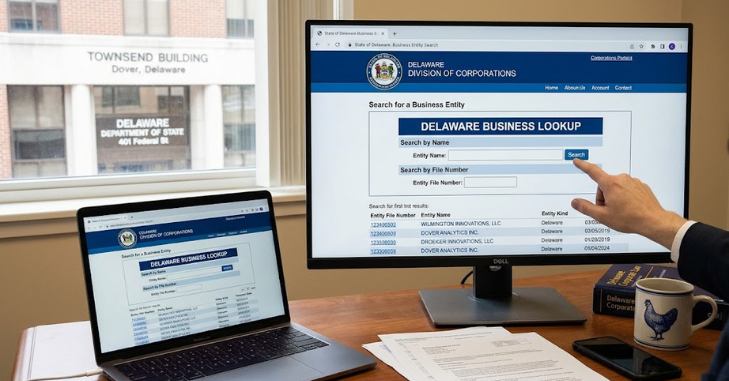
Finding a Delaware Business Lookup registered entity is straightforward when you use the official state system. Start with the information you already know about the company. A legal name usually produces a cleaner result than an informal brand name.
1. Open the official Delaware entity search. Use the Division of Corporations search service rather than an unofficial directory. As of November 2026, the state’s Division of Corporations entity search states that a name-search result is not a status determination. 2. Enter the entity name or file number. The search field is not case-sensitive. 3. Use quotation marks when appropriate. Delaware says quotation marks can help with exact-name searches. 4. Review the matching entities. The results list can include active and inactive registrations. 5. Select the correct entity. Open its information page to review available public details. 6. Use a paid service when necessary. Status, detailed histories, and certified documents require different options.
The Division also restricts automated data mining and excessive repeated searches. Its search system is intended for individual entity research. Businesses collecting data at scale should not automate requests against the public form.
What Information Does the Free Delaware Search Show?
The free entity page provides several useful facts about a registered organization. These details can help confirm that you found the correct company. They can also help distinguish businesses with similar names.
The free information generally includes the following fields.
* Entity name * Delaware file number * Incorporation or formation date * Entity kind or type * Residency information * Registered agent name * Registered agent address * Registered agent phone number
The registered agent should not automatically be treated as the company owner. Registered agents receive legal and official communications for an entity. Delaware does not provide every ownership or management detail through the basic search.
For example, Delaware states that shareholder or owner information is not maintained as ordinary public entity information. Current corporate officers and directors may appear in annual reports instead. Alternative entities also have different reporting requirements for members and managers.
Does a Free Search Show Whether a Company Is in Good Standing?
No, a free entity-name result does not confirm current good standing. Delaware provides a separate online status service for that purpose. The basic database can list an entity even when its status is not active.
As of November 2026, Delaware lists two online status options. A basic status check costs \$10 per entity. A \$20 option provides status plus added information, including recent filings and certain tax details.
Neither online option creates an official certificate of good standing. Businesses needing an official certificate must use Delaware’s document and certificate request process. That distinction matters for lenders, transactions, licensing requests, and other formal due-diligence needs.
Free Entity Search vs. Paid Delaware Records
| Service | Basic entity search | Online status | Detailed online status | Official certificate |
|---|---|---|---|---|
| Search by name | Yes | Yes | Yes | Entity must be identified |
| Basic entity details | Yes | Yes | Yes | Limited to certificate purpose |
| Current status | No | Yes | Yes | Yes |
| Recent filing information | No | No | Up to five recent filings | Depends on requested document |
| Tax information | No | No | Certain franchise tax details | No |
| Official proof of good standing | No | No | No | Yes |
| Listed online price | Free | \$10 | \$20 | Separate fee |
Choose the free search when you only need to identify an entity or verify its registration details. Use online status when a current status answer is enough. Request an official certificate when another organization specifically requires certified proof.
Entity Registration and Business Licensing Are Different
A Delaware entity registration does not necessarily mean the company actively operates inside Delaware. The Division of Corporations records legal entities formed or registered under Delaware law. A separate licensing system addresses businesses authorized to conduct taxable business activity in the state.
Delaware’s Business First Steps site specifically explains this difference. It directs users to Division of Revenue information for licensed operating businesses. It directs legal-entity searches to the Division of Corporations database.
This distinction matters during vendor checks and local business research. A corporation may legally exist in Delaware while conducting its operations somewhere else. Checking the correct database prevents a registration record from being mistaken for proof of a local business license.
Business owners dealing with broader compliance obligations may also benefit from BusinessVert’s coverage of regulatory compliance challenges. Registration, licensing, taxes, and industry rules can involve different agencies. Keeping those responsibilities separate makes compliance easier to track.
How to Search When You Do Not Know the Exact Company Name
Start with the strongest part of the legal business name you know. Avoid assuming punctuation, capitalization, or an informal trading name matches the registered entity. Searching broader terms can help when an exact search produces nothing.
You should also compare file numbers and formation dates when several names look similar. Registered-agent information can provide another useful clue. Those details reduce the chance of relying on records for the wrong organization.
If you are checking a planned company name, do not confuse entity lookup with name availability. Delaware maintains a separate name-availability process for formation purposes. A normal business search does not replace that availability check.
BusinessVert’s guide on starting an event planning business also covers choosing a structure and registering a business. Those steps are relevant to founders preparing their own filings. Existing-company research uses a different workflow.
Common Delaware Business Search Mistakes
Several mistakes can lead to incorrect conclusions from public records. Most happen because users expect the free database to provide information it was never designed to show. Understanding the database’s scope makes the results easier to interpret.
These are the most common mistakes.
* Assuming a search result proves good standing. * Treating the registered agent as the owner. * Expecting LLC members to appear automatically. * Confusing entity registration with a Delaware business license. * Using name search as a substitute for name availability. * Assuming free results include complete filing histories. * Relying on third-party directories instead of confirming official records.
For financial due diligence, entity research may be only one part of the process. Tax records, accounting documents, contracts, and operating licenses can answer different questions. BusinessVert’s tax audit guide for U.S. businesses explains why organized business records matter during formal reviews.
When Should You Order a Certificate of Status?
A certificate becomes useful when another party needs formal evidence of an entity’s standing. Banks, investors, government agencies, and transaction partners may request one. Their requirements can differ depending on the transaction.
Delaware offers short-form and long-form certificate options through its document request process. The state currently lists a \$50 fee for a short-form certificate. It lists \$175 for a long-form certificate with additional filing-history information.
Before ordering, ask the requesting party exactly what document it needs. Paying for a detailed certificate may be unnecessary when basic certification is acceptable. Likewise, a printed online status page may be insufficient when certified evidence is required.
Use the Right Delaware Record for Your Purpose
Start with the free entity database when you need basic information about a registered company. Move to the paid status service only when current standing or added history matters. Request certified records when a bank, regulator, or transaction specifically requires them.
The most useful search is one matched to the question you need answered. Entity registration, licensing, ownership, and good standing are separate issues. Checking the proper official source gives you a more reliable business record and reduces costly misunderstandings.
Frequently Asked Questions About Delaware Business Lookup
Is a Delaware business lookup free?
The basic Delaware business lookup is free through the Division of Corporations. It provides general entity and registered-agent details. Current status and more detailed information use separate paid services.
Can I search a Delaware company by file number?
Yes, Delaware allows entity searches using a company name or its file number. A file number can be helpful when similar business names appear. It provides a more precise way to identify the intended record.
Does Delaware show who owns an LLC?
The basic entity search does not provide a general public list of LLC owners. Delaware states that alternative entities are not required to list members or managers in the same way. Ownership information may therefore require other company records or filings.
Can I tell whether a Delaware company is active for free?
The free search can return both active and inactive entities. Delaware says the result itself is not a statement of current status. Use the separate status service when you need a current status determination.
Is a Delaware business search the same as a license search?
No, they answer different questions. The Division of Corporations search checks legal entities registered with Delaware. Licensing information for businesses operating in Delaware can involve Division of Revenue records instead.
Where can I get an official certificate of good standing?
Request it through the Delaware Division of Corporations document and certificate service. The online status screen is not an official certificate. Confirm the required certificate type before placing the order.