Commercial Mortgage Rates in 2026: What U.S. Borrowers Should Expect Before They Apply

Commercial mortgage rates vary widely across lenders, property types, loan structures, and borrower profiles. Rates in late 2026 remain well above pandemic-era borrowing costs. U.S. borrowers should compare total loan economics instead of focusing only on the advertised interest rate. Quick answer: Commercial mortgage rates in the United States currently vary by lender, property, leverage, and loan structure. In early November 2026, many conventional loans fall around the mid-6% to low-9% range. Bridge financing can run higher because lenders accept more property or execution risk. Also worth reading: Best Items to Resell Summer.
Commercial Real Estate Financing at a Glance
| Financing option | Recent indicative range | Typical use | Key consideration |
|---|---|---|---|
| Conventional commercial loan | 6.14% to 9.19% | Stabilized commercial property | Borrower strength and property type matter |
| Bank commercial mortgage | Around 6.78% to 7.51% for selected terms | Owner-occupied or investment property | Bank underwriting can vary substantially |
| CMBS financing | Roughly 6.48% to 7.14% in one market survey | Larger stabilized properties | Prepayment terms can be restrictive |
| Agency multifamily | Roughly 5.89% to 6.59% | Qualifying apartment properties | Available only for eligible multifamily assets |
| SBA 504 | Market-dependent fixed pricing | Owner-occupied business real estate | SBA and CDC eligibility rules apply |
| Bridge financing | Roughly 6.80% to 13% across recent sources | Transitional properties or short holds | Higher pricing and fees are common |
These figures are market indications, not guaranteed borrower quotes. Pricing changes as Treasury yields, SOFR, lender spreads, and credit conditions move. A lender must review the property and borrower before providing final terms.
Key Takeaways
* Commercial property loan pricing depends on the benchmark rate plus the lender’s required spread. * Fixed-rate loans often reference Treasury yields, while floating loans commonly use SOFR. * Lower leverage and stronger cash flow can improve the terms available to a borrower. * Property type, location, tenancy, and loan size can change lender appetite. * SBA financing can suit eligible businesses buying owner-occupied real estate. * Comparing fees and prepayment rules matters as much as comparing headline rates.
What Are Commercial Mortgage Rates Based On?

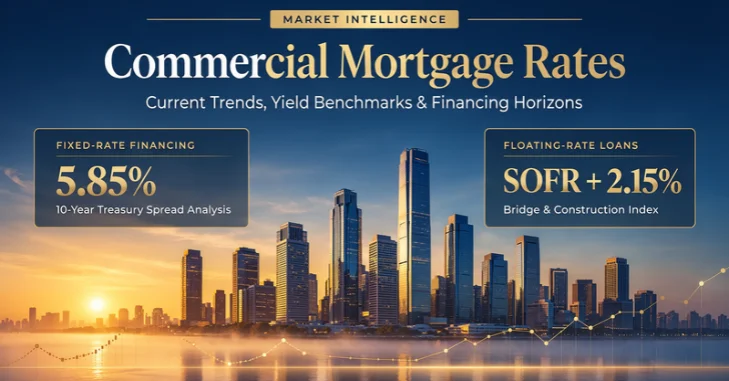
Commercial Mortgage Rates lenders don’t select a rate without reference to broader capital markets. Fixed-rate loans often use Treasury yields as their starting point. The lender then adds a spread reflecting risk, costs, and required returns. The 10-year Treasury yield was about 4.94% on October 30, 2026. Many longer fixed-rate property loans use that benchmark or a nearby Treasury maturity. U.S. Treasury yield data provides the underlying government yield information used across credit markets. Floating-rate financing works differently because it commonly references SOFR. The New York Fed reported overnight SOFR at 3.94% for October 29, 2026. A lender normally adds its contractual spread to that benchmark. For borrowers, this structure explains why rates can change without a lender changing its credit policy. The market index can rise or fall before loan closing. The lender’s spread can also change as property or borrower risk changes.
Current Commercial Mortgage Rates by Loan Type
Recent market sources show conventional commercial financing around 6.14% to 9.19% in early November 2026. One lender marketplace showed five-year bank commercial pricing near 6.78%. Its displayed ten-year bank rate was about 7.51%. CMBS pricing may sit in a similar range for qualifying stabilized properties. One November survey placed conduit indications around 6.48% to 7.14%. Actual pricing depends on leverage, asset quality, loan size, and the transaction date. Agency multifamily programs can price lower for strong apartment properties. Recent indications placed qualifying Fannie Mae and Freddie Mac financing near the upper-5% to mid-6% range. These programs don’t apply to ordinary office, retail, or owner-occupied business properties. Bridge debt usually carries a larger spread because lenders accept transitional risk. Borrowers may use it during renovations, lease-up periods, or other short-term business plans. That added flexibility can increase both interest costs and lender fees.
How Different Lenders Compare
| Lender type | Main advantage | Main drawback | Often suitable for |
|---|---|---|---|
| Banks | Relationship-based underwriting | Standards may vary by bank | Local businesses and established investors |
| Credit unions | Competitive local lending | Geographic or membership limits | Smaller owner-occupied properties |
| Agency lenders | Attractive multifamily terms | Narrow property eligibility | Stabilized apartment buildings |
| Life companies | Long-term fixed options | Often prefer stronger assets | Low-leverage stabilized properties |
| CMBS lenders | Can handle larger transactions | Complex prepayment provisions | Stabilized investment properties |
| Bridge lenders | Faster, flexible structures | Higher pricing | Transitional or renovation projects |
No single lender category wins for every transaction. A low-rate life company loan may not accept the same property as a bridge lender. Borrowers should compare lenders that fit the actual business plan. Existing banking relationships can also affect the process. BusinessVert explains how long-term lender connections work in its relationship banking guide. Relationship strength may help communication, although it doesn’t guarantee better approval terms.
What Determines the Rate You Receive?
Loan-to-Value Ratio
Loan-to-value compares the requested debt with the property’s value. Lower leverage gives the lender a larger equity cushion. That reduced risk can support better pricing or easier approval. A borrower seeking 60% financing may receive different terms from someone seeking 80%. Lender limits also depend on the property category. Hotels and transitional buildings may face stricter limits than stabilized apartments.
Debt Service Coverage Ratio
Debt service coverage ratio measures property cash flow against required loan payments. Stronger coverage suggests more room to absorb revenue declines or expense increases. Lenders often use DSCR as a central underwriting measure. Higher interest rates can also reduce a property’s qualifying loan amount. The same income supports less debt when required payments rise. Borrowers should calculate coverage using realistic expenses before requesting a specific loan size.
Property Type and Condition
Lenders evaluate whether a property produces stable and predictable income. Strong occupancy and diversified tenants can make underwriting easier. Deferred maintenance or major vacancies can create added risk. Property type also affects lender demand. Multifamily and industrial assets may attract different capital sources than offices or hotels. Local market conditions can further influence the spread offered.
Borrower Financial Strength
Commercial lenders often review liquidity, net worth, credit history, and operating experience. Strong borrowers may have more financing choices during difficult credit periods. Weak liquidity can create problems even when the property performs adequately. Personal guarantees also differ among loan programs. Some lenders require full recourse, while others may offer limited-recourse structures. The trade-off can affect pricing, documentation, and approval standards.
Loan Term and Amortization
A five-year loan doesn’t carry the same interest-rate exposure as a ten-year loan. Amortization also changes the required monthly payment. Longer amortization lowers scheduled payments but reduces principal more slowly. Borrowers should compare both maturity and amortization when reviewing offers. A low rate paired with a short amortization period can produce a higher payment. Balloon risk also matters when the loan matures before full repayment.
SBA 504 and 7(a) Options for Business Property
SBA 504 financing supports qualifying businesses purchasing major fixed assets, including eligible owner-occupied real estate. The program offers 10-, 20-, and 25-year maturity options. The SBA 504 loan program page states that 504 pricing is tied to market rates for U.S. Treasury issues. The SBA portion can reach $5 million for most eligible projects. Certain projects can qualify for a $5.5 million maximum. Borrowers generally work with a Certified Development Company and another lender. SBA 7(a) financing can also support eligible real estate purchases. Interest rates are negotiated with lenders but remain subject to SBA maximums. Variable-rate caps depend partly on loan size and an approved base rate. Business owners comparing funding sources can review BusinessVert’s U.S. finance coverage for related borrowing and financial topics. Its small-business news coverage also tracks policy and financing developments affecting U.S. companies.
Fixed vs. Floating Rates
Fixed-rate financing provides predictable interest costs during the fixed period. That stability can simplify cash-flow forecasts and investment return calculations. The trade-off may involve stricter prepayment rules or a higher initial rate. Floating financing changes with a benchmark such as SOFR. Borrowers can benefit if the benchmark declines after closing. They also face higher payments if the benchmark rises. Interest-rate caps can limit floating-rate exposure in certain transactions. Caps have their own costs and terms. Borrowers should include those expenses when comparing fixed and floating options.
How to Compare Commercial Loan Offers
Start by requesting comparable terms from several qualified lenders. Give each lender the same property information and requested structure. Consistent inputs make competing proposals easier to evaluate. Compare the interest rate, origination fee, appraisal costs, legal expenses, and required reserves. Review prepayment penalties and exit fees with equal care. A slightly higher rate may still produce a better total financing package. Next, check the lender’s proposed amortization schedule and maturity date. Model the monthly payment under realistic property income assumptions. Include a refinance scenario if a balloon balance remains at maturity. Finally, evaluate execution certainty. A cheap term sheet has limited value if the lender cannot close your property type. Ask about underwriting milestones, third-party reports, deposits, and estimated closing requirements.
Should You Wait for Rates to Fall?
Waiting can help if borrowing costs decline, but future rates are uncertain. Property prices, rents, occupancy, and lender spreads may also change while you wait. The financing decision should therefore start with project economics. Run the deal using today’s quote and a reasonable stress case. Calculate whether cash flow still supports payments if costs rise. A project that only works with a major future rate cut carries greater financing risk. Refinancing can be another option when economics improve later. Yet prepayment restrictions may limit that choice. Review exit terms before signing any long-term loan.
Compare the Full Deal Before You Borrow
A strong financing decision starts with several comparable lender proposals. Review rates, fees, leverage, amortization, recourse, and prepayment restrictions together. Then test whether the property’s cash flow supports the loan under less favorable conditions. Use current market benchmarks as a starting point rather than a promised quote. Speak with qualified lenders that actively finance your property type and location. Comparing three or more realistic proposals can reveal differences that headline rates hide
Frequently Asked Questions
What are commercial mortgage rates today?
Current U.S. pricing varies substantially by lender and property. Recent November 2026 sources place many conventional options between roughly 6% and 9%. Bridge and higher-risk financing can cost considerably more.
What is a good interest rate for a commercial property loan?
A good rate depends on the property, leverage, borrower, and available lender programs. The lowest advertised number isn’t automatically the best financing choice. Fees, amortization, recourse, and prepayment terms also affect total cost.
Are commercial rates higher than residential mortgage rates?
Commercial and residential loans use different underwriting methods and capital sources. Business property pricing reflects property income, borrower strength, and transaction-specific risks. Direct comparisons therefore don’t always provide useful conclusions.
How much down payment does a commercial lender require?
Required equity varies by lender, property, and loan program. Strong stabilized properties may support greater leverage than risky or transitional assets. Ask lenders for both maximum leverage and pricing at lower leverage levels.
Can I get a fixed-rate commercial property loan?
Yes, many banks, life companies, agency programs, and CMBS lenders offer fixed-rate structures. Available terms vary by lender and property. Prepayment provisions deserve careful review before choosing a fixed loan.
Does the Federal Reserve directly set commercial property loan rates?
No, the Federal Reserve doesn’t directly set each lender’s property loan rate. Its policy influences broader funding conditions and short-term benchmarks. Treasury yields, SOFR, lender spreads, and underwriting decisions determine actual pricing.