Concrete Driveway Cost in 2026: Complete Price Guide by Size, Thickness, Materials, and Labor Costs

Two contractors can walk the same 600-square-foot drive and hand you bids $6,000 apart. Neither one has to be dishonest. Concrete driveway cost in 2026 moves with square footage, slab thickness, ground conditions, and the finish you choose. Price those four separately, and a padded bid stops hiding.
Budget $8 to $18 per square foot installed in 2026. A 400-square-foot two-car pad with a broom finish lands around $3,200 to $5,600. Stretch that to 600 square feet, and you are looking at $4,800 to $8,400. Stamped work on a large drive can pass $20,000. Plain gray starts at around $6.
Concrete driveway cost at a glance
| Line item | 2026 figure | What it covers |
| Installed price | $8 to $18 per sq ft | Broom finish, standard 4 inch slab |
| Two car pad, 400 sq ft | $3,200 to $7,200 | A 20 by 20 foot rectangle |
| Ready mix delivered | $119 to $147 per cubic yard | Within 20 miles of the batch plant |
| Materials share | $3 to $8 per sq ft | Concrete, base rock, mesh, forms |
| Labor share | $3 to $7 per sq ft | Roughly 40% of a typical bid |
| Tear out of the old slab | $1 to $4 per sq ft | Plus $500 to $1,000 for disposal |
| Permit | $50 to $200 | Charged by most municipalities |
| Sealing | $0.50 to $2.50 per sq ft | Repeated every few years |
Key takeaways
- Square footage sets the scale. Finish sets the multiplier.
- Materials account for roughly a third to a half of the bill, and labor, equipment and margin swallow the rest of what you pay.
- Four inches is standard. Six is for trucks, RVs and delivery vans.
- Demolition of the old surface is a separate line, not a courtesy.
- Two honest bids can differ by thousands purely because one crew specified a deeper compacted base than the other did.
Price per square foot in 2026
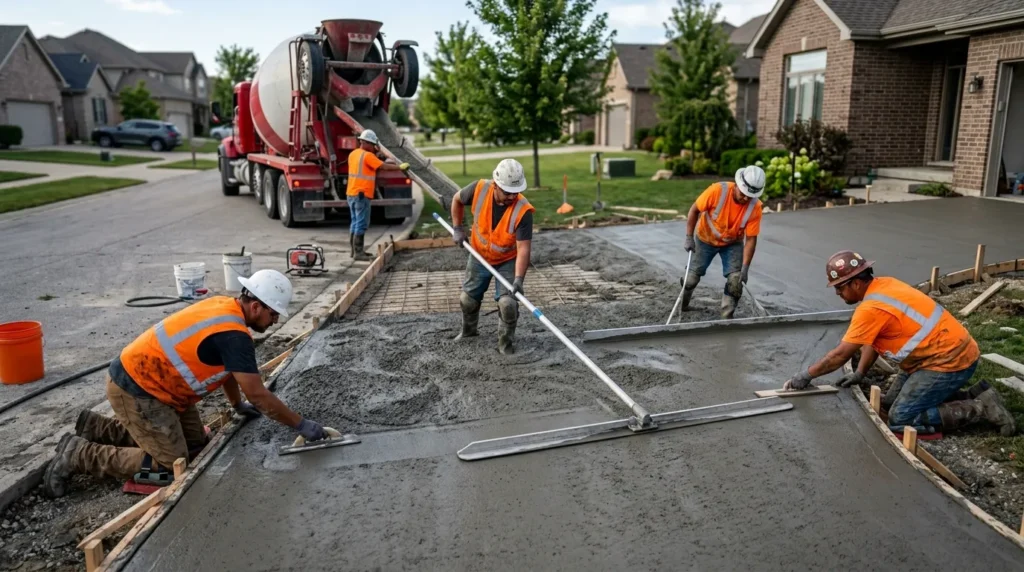
Every estimate starts here. Published ranges look confusing because they measure different things. Concrete Network puts a plain gray slab with a broom or rock salt finish at $5 to $8 per square foot, and HomeGuide lands at $6 to $15. RemodelingExpense quotes $8 to $18 installed. Angi’s 2026 figures run $8 to $20.
That spread is not a disagreement. Lower numbers usually price the concrete and the pour, while higher ones fold in demolition, grading, reinforcement, and a decorative finish on top. Ask before you compare.
What size does it take to the bill
Area is the biggest single lever on concrete driveway cost, and it is the one homeowners underestimate. Widening a 20-foot drive by four feet adds a fifth to the price. The table below multiplies 2026 installed rates by area so that you can place your own dimensions before anyone visits.
| Driveway | Square feet | Broom finish ($8 to $14/sq ft) | Integral color ($11 to $19/sq ft) | Stamped or decorative ($14 to $28/sq ft) |
| 1 car, 10 by 20 ft | 200 | $1,600 to $2,800 | $2,200 to $3,800 | $2,800 to $5,600 |
| 1 car long, 12 by 24 ft | 288 | $2,300 to $4,000 | $3,200 to $5,500 | $4,000 to $8,100 |
| 2 car, 20 by 20 ft | 400 | $3,200 to $5,600 | $4,400 to $7,600 | $5,600 to $11,200 |
| 2 car wide, 24 by 24 ft | 576 | $4,600 to $8,100 | $6,300 to $10,900 | $8,100 to $16,100 |
| 3 car, 24 by 36 ft | 864 | $6,900 to $12,100 | $9,500 to $16,400 | $12,100 to $24,200 |
| Long rural drive | 1,000 | $8,000 to $14,000 | $11,000 to $19,000 | $14,000 to $28,000 |
The ground comes first, and it is never free
Concrete is the visible half of the job. Under it sits compacted gravel, and under that sits whatever your yard was doing before. Bidders who skip this part are the ones whose slabs crack in year three.
Removing an old surface runs $1 to $4 per square foot, and hauling the rubble away adds $500 to $1,000 on a typical residential job. Grading a sloped or rutted site costs $700 to $2,500. Base rock is cheap at $10 to $50 a ton, but a 600-square-foot drive needs about ten tons.
Drainage is where the surprises live. A drive that sheds water toward a garage door needs a channel drain or a regrade. A drive cut into a bank may need a retaining structure before any forms go down. On residential lots, rock retaining walls are one of the common answers, and they belong in the budget from day one rather than as a change order.
What each finish adds
Finish is the line item people enjoy spending on, and it is also the easiest place to overspend. Here is what the four common choices cost installed in 2026.
| Finish | Installed cost | What you get | Worth it when |
| Plain gray | $6 to $8 per sq ft | Flat troweled slab, no texture | Budget is the only constraint |
| Broom finish | $8 to $12 per sq ft | Brushed grip lines across the surface | Almost every standard driveway |
| Exposed aggregate | $8 to $12 per sq ft | Washed surface showing the stone | You want texture without a premium |
| Integral color | $8 to $12 per sq ft | Pigment mixed through the load | The tone must not wear off |
| Stamped | $12 to $18 per sq ft | Pattern pressed into wet concrete | Curb appeal is the point of the job |
Notice that exposed aggregate and integral color sit in the same band as a plain broom finish. Stamping is the jump. On a 576-square-foot drive, that choice is worth roughly $2,300 to $3,500 over broom, before anyone talks about stain accents.
Thickness: What one extra inch really costs

Four inches is the residential standard for cars and light trucks. Six inches answers an RV, a loaded work truck, or a drive that takes delivery vehicles and heavy trailers week after week. HomeGuide prices four-inch slabs at $6 to $15 per square foot and six-inch slabs at $8 to $20 per square foot.
Arithmetic makes this clearer than any quote does. One inch of concrete over 100 square feet is 8.33 cubic feet, or 0.31 cubic yards. At $119 to $147 delivered, that inch costs $37 to $46 per 100 square feet, so about $0.40 per square foot. Taking a 600-square-foot drive from four inches to five adds roughly $220 to $270 of ready mix. That is it.
Contractors charge more than the raw material for that inch, because the pour takes longer and the edges get deeper. Even so, the gap between the material cost and the quoted upcharge is worth asking about. Public specifications set a useful benchmark. The Tennessee Department of Transportation’s driveway guide calls for six inches of concrete where a private drive crosses a state route. That rule is why your apron may be thicker than the rest of the slab.
Materials only versus the installed quote
Almost no cost guide separates these two numbers. That split is what tells you whether a bid is reasonable. Below is a 600-square-foot drive at four inches, costed as materials and then as a finished job.
| Item | Materials only |
| Ready mix, 8.1 cubic yards including 10% waste | $964 to $1,191 |
| Gravel base, about 10 tons | $100 to $500 |
| Wire mesh or fiber reinforcement | $600 to $900 |
| Forms, stakes and joint sealant | $100 to $200 |
| Materials subtotal | $1,764 to $2,791 |
| Same drive, professionally installed | $4,800 to $10,800 |
So materials run about $2.94 to $4.65 per square foot. Labor, equipment, insurance, waste handling, and the contractor’s margin absorb everything above that line. Bob Vila puts labor at roughly 40% of a concrete driveway bill. That fits the table almost exactly.
Those material figures also keep climbing. Producer prices for ready mix are about 39% higher than in January 2021, according to the U.S. Bureau of Labor Statistics, whose index for ready-mix concrete manufacturing read 402.0 in June 2026 against 290.1 in January 2021. Any cost guide still quoting 2021 prices will understate your bid by a wide margin.
Is concrete cheaper than asphalt, gravel or pavers?
It sits in the middle. Gravel is cheapest at $1 to $3 per square foot, but it migrates, ruts, and needs topping up. Asphalt runs $5 to $12 and goes down faster, but it wants resealing every few years and softens in heat. Pavers cost $10 to $30, and a damaged one lifts and resets without disturbing the ones beside it. That repairability is worth real money over twenty years.
Concrete’s argument is the middle ground: a higher upfront number than asphalt, far less upkeep, and a surface that installers commonly expect to last 30 years or more. If you plan to stay put, the annualized cost usually favors the slab.
Why two bids on one driveway differ by thousands
Price gaps almost always trace back to something specific rather than greed. Ask each bidder to write down these five items. Most of the mystery then disappears.
- Slab thickness in inches, and whether the apron is thicker.
- Compacted base depth, and the type of aggregate used.
- Reinforcement: fiber, wire mesh, or rebar on a grid.
- Control joint spacing, and whether joints are cut or tooled.
- Whether demolition, haul away, and permit fees are included or excluded.
A bidder using fiber over a three-inch base always beats one specifying rebar over six inches of rock. The cheap bid is not a bargain if it cracks. The same vetting logic applies to any exterior trade, and these questions to ask a home construction company translate directly to a concrete crew.
Sealing, cracking and the cost of doing nothing
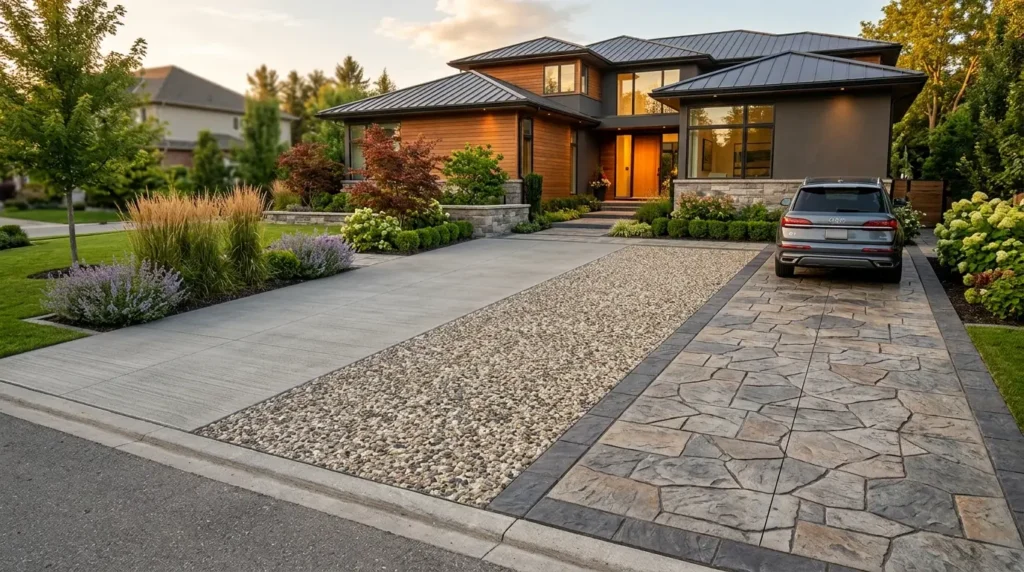
Sealing costs $0.50 to $2.50 per square foot and gets repeated every few years. On a 600-square-foot drive, that is $300 to $1,500 a cycle. Skipping it is tempting and expensive: de-icing salt, freeze cycles, and oil all attack an unsealed surface, and resurfacing later runs $3 to $10 per square foot.
Small cracks are normal and are what control joints exist to manage. Wide, lifting, or spalled sections are a base failure, and patching rarely holds. Deferred upkeep on any hard surface follows one curve, set out in this look at the hidden cost of neglecting a property’s exterior. A cheap annual task quietly turns into a capital replacement.
Getting a number you can budget from
Measure the drive, pick a finish, and multiply by the rates in the size table. That gives you a defensible bracket before a single truck arrives. Then get a quote from three local concrete contractors, hand each one the same written scope, and compare their five specification answers line by line rather than comparing totals. The bid that explains its base depth and joint spacing is usually the one worth signing.
Frequently asked questions
A 20 by 20 foot pad is 400 square feet. With a broom finish, that is roughly $3,200 to $5,600. Stamp it, and you are at $5,600 to $11,200.
Four inches for cars and light trucks. Go to six inches for an RV, a loaded work truck, or a driveway that sees delivery vehicles weekly.
Walking traffic is usually fine after 24 to 48 hours. Most crews ask you to keep vehicles off for seven days, and heavy vehicles off for 28.
It rarely returns the full spend, but a cracked, sunken drive is a visible defect that buyers price down hard. Replacing one mostly removes a discount rather than creating a premium.
Sometimes, and it is called an overlay. It only works if the existing slab is sound, drainage still runs the right way, and the extra height does not foul the garage threshold.