The Silent Powerhouse: Why Your Gadgets Deserve a Quality Rechargeable AAA Batteries and Charger

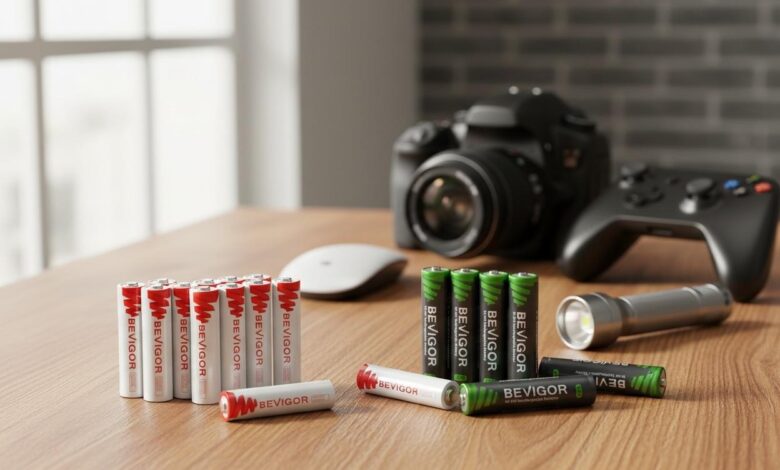
We often treat the small, silver-and-black cylinders we slide into our TV remotes or gaming controllers as a simple commodity—something to be bought in bulk and tossed in the trash without a second thought. But viewing power this way misses the incredible engineering happening right under the metal skin. When you choose a rechargeable AAA batteries and charger setup, you aren’t just buying “juice”; you are investing in a miniature, reversible chemical power plant.
Think of it like this: your devices are hungry engines. To run smoothly, they need a specific type of fuel delivered with precision. Much like how hearing aid batteries utilize specialized zinc-air technology to pull oxygen from the atmosphere—effectively doubling the capacity of the cell to meet the high-power demands of a digital processor—modern NiMH (Nickel-Metal Hydride) cells are designed to store and release energy over and over again. For a high-drain device like a wireless mouse or a portable blood pressure monitor, having a reliable rechargeable AAA batteries and charger isn’t just a convenience; it is a requirement for the device to perform as it was designed.
Understanding the Chemistry of Your Rechargeable AAA Batteries and Charger
Most of us grew up using alkaline batteries, which are essentially a “one-way street.” Once the chemical reaction inside is finished, the battery is dead. In contrast, the chemistry inside the cells used in a rechargeable AAA batteries and charger kit is designed to be “rewound.” When you plug them into a wall, you are forcing electrons back into their starting positions so they can do work all over again.
Why Efficiency in a Rechargeable AAA Batteries and Charger is a Requirement
The biggest enemy of a rechargeable battery is heat. When a charger pushes energy into a cell too quickly, the internal resistance of the battery creates thermal energy. This is governed by the formula for heat dissipation:
$$Q = I^2 \cdot R \cdot t$$
In this equation, $Q$ is the heat generated, $I$ is the current, $R$ is the internal resistance, and $t$ is time. A cheap, “dumb” charger ignores these variables and keeps pumping current even when the battery is full. This “cooks” the internal components, causing the battery to lose its ability to hold a charge. A high-quality rechargeable AAA batteries and charger uses a “smart” microchip to monitor the voltage and temperature, cutting the power the millisecond the battery is full. This ensures your rechargeable AAA batteries and charger stays healthy for years rather than months.
Real-World Lessons from Reddit on Choosing Rechargeable AAA Batteries and Charger
If you want the unvarnished truth about battery life, you go to the places where enthusiasts hang out. On subreddits like r/flashlight and r/batteries, users treat their power sources with the same respect a mechanic treats an engine.
One Reddit user, u/VoltageViking, shared a story that many of us can relate to. He had been buying cheap disposable AAA batteries for his kids’ toys for years. “I was spending $40 a month just to keep the noise-making toys alive,” he wrote. “In early 2025, I finally bought a professional-grade rechargeable AAA batteries and charger. It’s now 2026, and those same 12 batteries have been through 50 cycles each. They’ve already paid for themselves four times over, and my junk drawer isn’t full of leaking alkaline shells anymore.”
Quora Insights: The Hidden Dangers of a Bad Rechargeable AAA Batteries and Charger
On Quora, the discussion often turns to the “hidden” cost of cheap chargers. A contributor who works as an electrical engineer explained that most people blame their batteries for “dying” when the charger is actually the culprit.
The community consensus is clear: avoid chargers that charge batteries in pairs. If you have a rechargeable AAA batteries and charger that requires you to put in two batteries at a time to start the process, the charger is likely treating them as one big battery. If one is 20% full and the other is 50%, the charger will overcharge the second one while trying to fill the first. Always look for rechargeable AAA batteries and chargers with “independent channels,” which allows each battery to have its own dedicated “brain” during the recharge.
How to Maximize the Life of Your Rechargeable AAA Batteries and Charger
To get the most value out of your investment, you need to treat your batteries like the living chemical systems they are.
| Feature | Low-End Charger | High-End Smart Charger |
| Charging Logic | Timer-based (Dangerous) | Delta-V Detection (Safe) |
| Channels | Shared (Pairs only) | Independent (1 to 4 cells) |
| Heat Management | None | Thermal Sensors |
| Battery Health | Shortens life | Extends life to 1,000+ cycles |
Environmental Impacts of Switching to a Rechargeable AAA Batteries and Charger
Beyond the money saved, the environmental “why” is undeniable. A single high-quality cell in a rechargeable AAA batteries and charger set can replace up to 1,000 disposable batteries over its lifetime.
When you think about the mining of heavy metals and the carbon footprint of shipping thousands of heavy alkaline batteries to your local store, the choice becomes more than just a financial one. Using rechargeable AAA batteries and a charger is a vote for a “circular economy.” Instead of a linear path from the factory to the landfill, your energy stays in a loop, sitting on your shelf, ready to be refilled whenever the “fuel” runs low.
Why This System is Your Best Tech Investment
In a world that is moving toward 2027 and beyond, our reliance on portable power is only growing. We have smart locks, wireless keyboards, and health sensors that all rely on the humble AAA size. Treating your power source as a commodity is a recipe for frustration and wasted money.
By investing in high-quality rechargeable AAA batteries and chargers, you are taking control of your tech. You are ensuring that your devices have the high-density fuel they need to work perfectly, and you’re protecting your expensive gadgets from the “leaking” disasters that common alkaline batteries often cause.
Stop thinking of batteries as something you “use up” and start thinking of them as something you “manage.” Your wallet, your devices, and the planet will all be better for it.
Are you still using “pair-charging” units, or have you made the switch to a smart charger that monitors each cell individually?
Apart from that, if you want to know more about Cheap Stocks to Buy Now: Affordable Investment Opportunities for 2025 then visit our Industry category.